
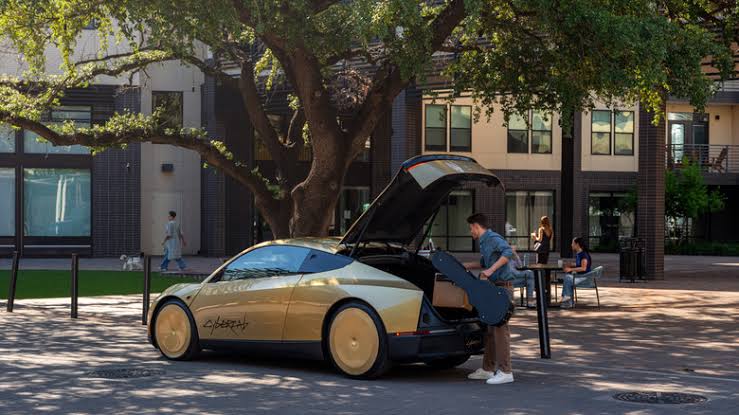
Tesla wants to put the Cybercab in customers’ hands this year. The company announced on its third-quarter earnings call that it will start selling the autonomous two-seater by the end of 2026. The catch is that federal regulators are still investigating whether the vehicle meets safety rules.
What Tesla Announced
Lars Moravy, Tesla’s vice president of engineering, said every Cybercab built so far is headed to Tesla’s own robotaxi fleet. As that fleet grows, the company plans to start delivering fully autonomous vehicles to customers, beginning in small numbers. Tesla says it will scale up as it learns more about delivery, ownership and fleet management for self-driving cars.
The Cybercab is a gold-colored two-seater with no steering wheel and no traditional driver controls.
Not a Car for the Driveway
Elon Musk made clear who the Cybercab is for. He described it as a vehicle built mainly for transport as a service, while Tesla’s other models, such as the Model 3, Model Y and Roadster, are the ones people want to own. He said most Cybercabs will stay owned and operated by Tesla.
Tesla first floated selling the vehicle to third parties around its Austin Cybercab event last month and posted an interest form for prospective robotaxi buyers. Until now, it wasn’t clear whether the company would follow through.
A Shift From Tesla’s Original Robotaxi Plan
Musk spent years pitching a giant fleet built from privately owned Teslas that would turn into self-driving taxis through a software update. That plan hasn’t materialized, and his latest comments show his thinking has changed.
Today, owners can subscribe to Full Self-Driving (Supervised), which automates many driving tasks but still requires a human ready to take over. Musk said an unsupervised version of FSD should reach customers in the second quarter of next year. That is another delay for owners who paid for the software years ago.
The Awkward Timeline
If both dates hold, fleet buyers could get a fully autonomous Cybercab before regular Tesla owners get that capability in their own cars. Businesses could potentially run Cybercabs as a robotaxi service while owners are still waiting for unsupervised FSD.
The NHTSA Investigation
The biggest roadblock is regulatory. The National Highway Traffic Safety Administration (NHTSA) opened an investigation into the Cybercab last month, just hours after the vehicles began running on public streets in Austin.
The issue centers on Federal Motor Vehicle Safety Standards (FMVSS), which call for manual controls like brake pedals and for mirrors, among other features. Automakers self-certify compliance, and Tesla did so for the Cybercab. Current rules don’t account for vehicles without manual controls, though the Department of Transportation recently proposed dropping those requirements for cars designed to drive themselves.
NHTSA says it will examine the process and technical data Tesla relied on when certifying the vehicle. The outcome could affect whether Tesla, or any buyer, can legally operate the Cybercab.
What to Watch Next
- Whether Tesla actually delivers Cybercabs to outside customers by December 31
- How NHTSA’s investigation unfolds and what it finds
- Whether the DOT’s proposed rule changes for vehicles without manual controls move forward
- Progress on unsupervised FSD in the second quarter of 2027
Source: TechCrunch