
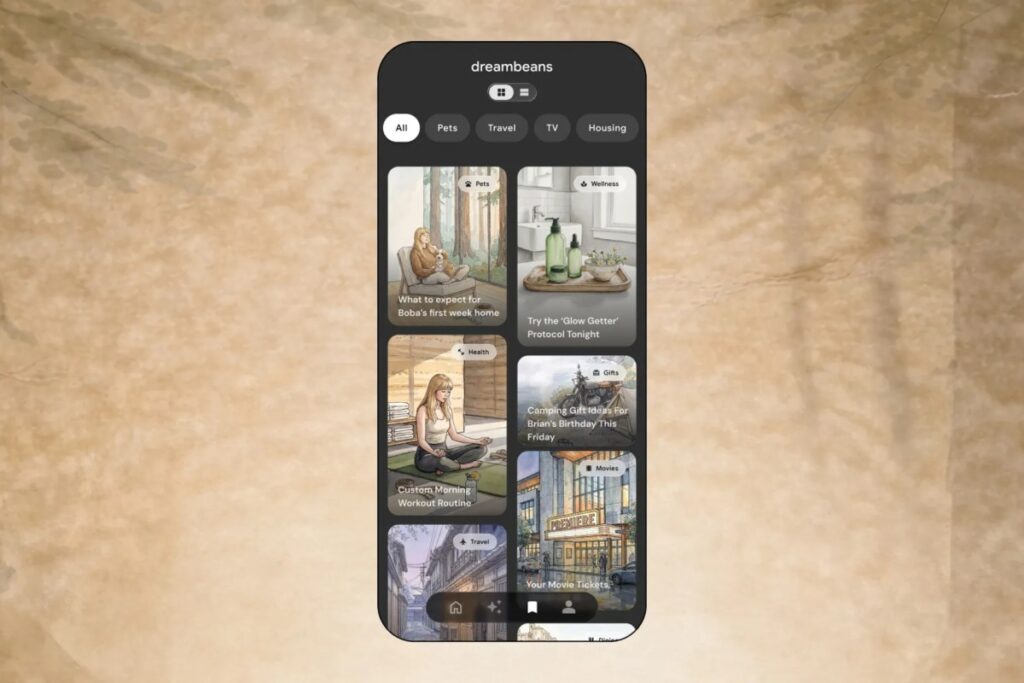
Google is testing a new idea on a very large audience. Its experimental AI app Dreambeans, which creates personalized illustrated stories from your digital life, has expanded beyond the U.S. for the first time, and India is the destination.
Quick Facts
- App: Dreambeans, a Google experimental AI app on Android and iOS
- New market: India, Google’s first expansion outside the U.S.
- Languages: 13 Indian languages plus English, including Hindi, Punjabi, Tamil, Telugu and Bengali
- Who can use it: Adults 18 and older
- Source: TechCrunch (reporter Jagmeet Singh, November 2, 2026)
What Dreambeans Does
Dreambeans pulls from connected Google services, including Calendar, Gemini, Gmail, Photos, Search and YouTube, then proactively generates illustrated stories about your interests and everyday life. You don’t need to type a prompt. The app launched in June with static AI-generated illustrations, and Google has since added Veo-powered animation to select stories.
Why Google Chose India First
Google says Indian users expressed strong interest in the app, and its services are widely used in the country. Product manager Gozde Oznur said India stands out for the high overlap of people using Gemini, Gmail and Google Photos together, which gives the app more material to work with.
How Dreambeans Is Doing in the U.S.
The numbers are modest. Sensor Tower estimates about 55,000 U.S. downloads since June, with roughly 63% arriving in September, when Google opened the app to all eligible adults. Downloads fell about 84% in October to around 5,500.
Compared with general-purpose AI apps, the first-month totals look small. In their first 30 days after launch, Dreambeans recorded roughly 29,000 downloads, versus 7.4 million for Meta’s Muse, 2.8 million for ChatGPT, 362,000 for Grok Bot and 155,000 for Claude. Those apps handle broad requests, while Dreambeans focuses on personal storytelling, so the comparison isn’t perfectly fair.
The Hinglish Problem
Users can pick only one language at a time for their stories. The app can read information in multiple languages across Google services, but it can’t yet mix languages in a single story. That’s a limitation in a country where many people switch between Hindi and English, often blending the two into Hinglish.
Privacy: The Big Question
Dreambeans relies on Google’s Personal Intelligence technology and personal account data. Those services can contain sensitive information, and some people won’t want an AI app digging through it for entertainment.
Google points to several controls:
- Users choose which services to connect and can disconnect at any time.
- Data can be deleted inside the app, and deleted source data also leaves Dreambeans’ personalization system.
- Users can tell the app to avoid topics, including business-related information.
- It works only with personal Gmail accounts, not enterprise accounts.
- Generated stories are visible only to the account holder.
The Emotional Risk
A proactive app can surface memories you’d rather skip. Oznur acknowledged that stories might involve people who have died. Users can tell Dreambeans to stop showing certain subjects, similar to memory controls in Google Photos.
What’s Next
Google is exploring ways to make Dreambeans more actionable, moving from stories and recommendations toward helping users act on suggestions.
What It Means for Users
- Early access: Indian users get a novel AI experience in their language.
- Review permissions: Think carefully about which services you connect.
- Expect changes: The mixed-language limit and future features may evolve.
What to Watch Next
Look for India download trends, support for mixed-language stories and whether Google adds more actions to the app.
Source: TechCrunch